Arsene Wenger wants simultaneous kick-offs for the title run in: would this favour Arsenal? (Flickr: Football Nomad)
Arsene Wenger cast doubts over the mental toughness of his Arsenal side this week with suggesting that the final three rounds of Premier League matches should kick off simultaneously.
It’s an unheard of suggestion that will almost certainly be ignored by the Premier League and more importantly the television companies, who wouldn’t stand to benefit from such a scenario.
The justification provided by Wenger was simple enough:
Read more…
Can Scott Parker be England’s holding midfielder?

Can Scott Parker replace Gareth Barry as England's holding midfielder? (Flickr: BRMB)
Alan Curbishley is the latest unemployed manager to give his thoughts on the England national team, following Glenn Hoddle’s accusation that the team under Capello are “very rigid”.
Speaking to Richard Keys and Andy Gray on Talksport, Curbishley gave his backing to Scott Parker as the player England need in central midfield. He said of Parker:
History provides no guidance on Houllier’s future

Villa fans voice their views on Gerard Houllier, but the board can be forgiven for not knowing what to do (Paul Childs/Action Images)
Aston Villa’s 1-0 defeat to Wolves on the weekend heaped more pressure on Gerard Houllier, who now appears to have alienated fans along with his players following a string of disappointing results.
The Holte end made its feelings clear during the game, and despite backing from the board one feels Houllier is very close to leaving Villa Park.
Would there be much sense in sacking Houllier at this stage of the season, with 8 games left? The club are in an extraordinarily precarious position; in fourteenth place but only one point above the relegation zone. I wondered if there was a precedent for sacking managers in similar positions, and looked at all relegation-related managerial departures from the past 8 seasons.
The facts about goal-line technology
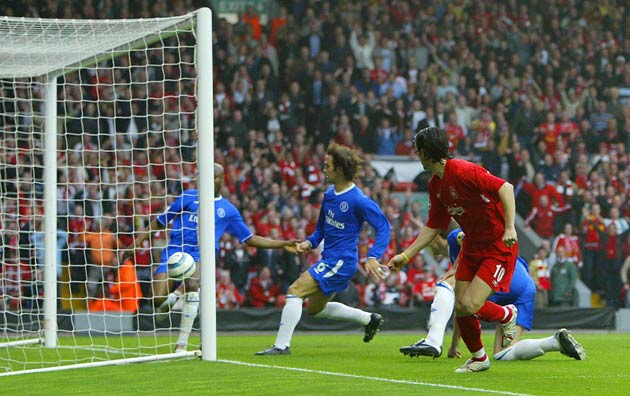
Goal-line technology would tell us if Garcia's effort crossed the line, and would not take "5 minutes" as Robbie Savage suggests (Getty Images)
Robbie Savage is attempting to forge a career as a top pundit, but he’s already begun to demonstrate some of the ignorance also shown by many ex-professionals in the media.
A couple of months back he argued against zonal marking, a debate for another time but for now let’s assume it’s a misguided opinion (and it is). Last night he opened up a debate on goal-line technology, and I was shocked at how uninformed he was, and wondered if most footballers are equally unaware.
Bin Hammam is not FIFA’s saviour

Mohamed Bin Hammam is running for FIFA presidency against Sepp Blatter, but is he really the lesser of two evils? (Flickr: Soccerex)
The prospect of Sepp Blatter’s term as FIFA president has been greeted with much delight in sections of the British press. Blatter has been accused of being anti-English and unfit to control a corrupt institution, and the announcement that Asian Football Confederation (AFC) Chairman Mohamed Bin Hammam will run against him on June 1 has led some to suggest that FIFA will undergo numerous changes under new leadership.
Bin Hammam has made promises that certainly appeal to the English football-supporting public, but it’s odd that very few media outlets have performed any sort of character check on the Qatari.
Does Jamie Redknapp even watch football?

Jamie Redknapp: clueless (Flickr: iron_smyth48)
Sky are in a dark place after the departure of Andy Gray and Richard Keys. Commentators Glenn Hoddle and Kevin Phillips have proven themselves to be less than adequate replacements, whilst much of the punditry team remains poor and agents of hyperbole.
I’ve been critical of Jamie Redknapp before, and I imagine I’ll continue to criticise his incompetence whilst he remains on air and has his words printed. His latest comments on the Mail Online are indicative of his general laziness.
The pointless obsession with the England captaincy

Ferdinand and Beckham: two England captains, no World Cup wins. (Flickr: Thirsty Robot)
The suggestion that John Terry will wear the armband for England later this month has led to cries of outrage. Capello has been called “weak” in some corners, “naive” in others.
Rio Ferdinand also appears to have thrown his toys out the pram; the BBC claims he is “very upset” over the entire situation.
The England football captain has always been an iconic figure, and those appointed will always talk of their “pride to lead the Three Lions out”. Why captains have become so iconic is less clear, particularly when only one has ever lifted a major trophy.
The curse of the early kick off?

The Manchester derby last season produced 7 goals, despite being played at lunchtime (Flickr: Ifotbol)
Football fans and pundits alike often bemoan the lack of Saturday 3 o’clock kick offs in the Premier League. At typical Saturday will now rarely see more than five or six matches kicking off at the traditional time, and it usually becomes even worse in weeks that feature Thursday night Europa League action.
Whilst the late Saturday match is a relatively recent innovation, Sky have tinkered with the lunchtime kick off for a number of years, and appear to have settled on 12.45pm. On Sundays, the norm is now a 1.30pm game followed by a 4pm kick off. Sometimes, particularly on big derby days, we’ll see three consecutive matches from 12pm.
One of the biggest accusations of early kick offs is the lack of excitement they are seen to produce. Phrases such as “the players look lethargic” and “it’s a little too early for the fans” have become synonymous with these games.
Jack Wilshere’s misunderstood talent

Jack Wilshere's passing, not willingness to get 'stuck in', should be encouraged (Ronnie Macdonald)
It’s been fashionable to talk about Jack Wilshere this February, and rightly so. The young Englishman won his full England debut at the start of the month, and a week later put in a man of the match performance against Barcelona in the Champions League.
He’s given fans of English football plenty of hope, despite statistics suggesting that the state of grassroots football in England is scarily poor. But a couple of columns I’ve read over the past few days suggests to me his talent is to an extent misunderstood, or that certain members of the media have overvalued aspects of his game.
Does coming second in your group affect your Champions League hopes?

Liverpool topped their group in 2008-09, but still drew the mighty Real Madrid (RAFA RIVAS/AFP/Getty Images)
Come the final round of matches in the Champions League group stage, and most managers and pundits will tell you the value of topping your group so as to theoretically avoid tougher opponents in the second round.
There’s enough evidence this season to suggest this largely holds true – Manchester United, Chelsea and to an extent Spurs all received easier draws than Arsenal’s tie with Barcelona, despite the Gunners’ first leg heroics.
But has this been the case since the 2003-04 season, when UEFA changed the tournament’s second round format from a group stage to a two-legged knockout tie? I’ve looked at English clubs’ involvement of each of these seasons, and observed whether clubs do receive easier draws for topping their group, and whether this affects their overall chances in the competition.

 5 Added Minutes