Football Democracy: Summary
 Firstly, a big thank you to those who took the time to participate in this small project, in which I am trying to establish the ‘true’ popularity of each Premier League team. For the uninitiated, more details are available in an earlier post.
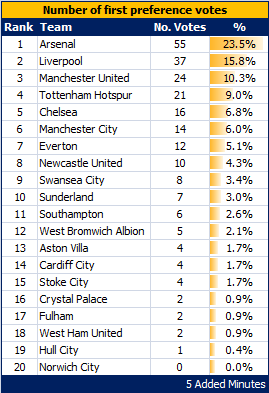
Each respondent was asked to rank the Premier League teams by preference, from their favourite team to their least favourite team. Historically, Manchester United have dominated these kind of polls, but whether due to the small sample (234 replies) or type of Twitter followers I have, Arsenal won 23.5% of the first preference votes in this example.
A small project: Football Democracy
 If you haven’t the time to read through my (geeky) explanation of why I’m attempting this project, please take 30 seconds to rank the Premier League teams by your order of preference:
Football Democracy survey: Ranking Premier League Teams
For the rest of you; a few thoughts.
Are England international football’s most consistent team?
 As the Football Association prepares to evaluate the current state of English football, I thought I’d provide a different perspective on the results of the national team, by looking at the consistency of performance.
The term ‘consistency’ in this post doesn’t refer to match-to-match consistency, but rather the variability of the strength of a national team on a year-to-year, or even decade-to-decade basis.
Power Laws and Goals
 I recently re-read a post by Soccer Statistically’s Ford Bohrmann, which showed how goals are distributed across players in a season. Although the ‘average’ player scores 1.83 goals in a season, this is highly deceptive because goals aren’t distributed normally across players.
In fact, this distribution can be modelled by power laws, whereby a lot of players score zero goals, fewer players one goal, even fewer players two goals and so on.
What is a ‘mid table finish’?
 Pre-season predictions often describe each of the 20 Premier League teams in one of the following terms: ‘title contenders’, ‘competing for Europe’, ‘mid-table team’ and ‘relegation candidates’. Three of the four are relatively tangible, and teams can eventually be assessed on whether they won the league, qualified for Europe or avoided relegation.
A mid-table position is slightly harder to define. In theory, this should be anywhere between 9th and 12th in the table, but the reality is that teams in these positions needn’t necessarily have been safe from relegation, nor out of the running for Europe.
England Batsmen: Averages
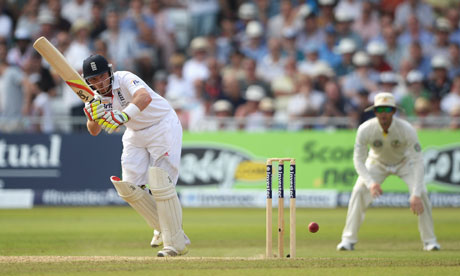 Thanks in part to television graphics, a batsman’s average in cricket is one of the key benchmarks for evaluating his ability. It is, in effect, the number of runs he brings on average to his team every time he comes to the crease.
However, we rarely see how much a batsman brings once he’s already been at the crease for a certain period of time. When a batsman is ‘in’ – having scored 10, 20 or 30 runs – how many runs do we expect him to score?
With the start of another Ashes series imminent, I’ve looked at four of England’s key batsman – Alastair Cook, Kevin Pietersen, Jonathan Trott and Ian Bell – and examined how their averages change over the course of an innings.
European Under-21 Championships: Relative Age Effect
 The relative age effect is a widely-acknowledged phenomenon in sport; whereby participants born soon after an age cut-off date are disproportionately represented compared to those born nearly 12 months later.
To what extent does this effect exist in the European Under-21 Championships, and what are some of the implications?
The cut-off for the Championships is on 1st January, 23 and a half years before the competition*. The theory argues that players born in December are less likely to be picked, having been left behind by their older, stronger peers.
This is somewhat borne out in the data, though there appears to be an effect through the academic year cut-off, which is 1st September in most European countries. Read more…
European Under-21 Championships: Senior Caps

The European Under-21 Championships is billed as a competition designed to give the stars of the future an opportunity represent their national team in front of a significant audience.
But how good are the Championships as a predictor of future success? How many players go on to represent the senior team, if they haven’t done so already? 75%? 50%? Less?
Looking at European Under-21 squads between 1994 and 2006 – a sample of 941 outfield players* – it turns out that 61% of players did eventually win a full international cap. Members of squads in the 2006 Championships are at least 30 now, and therefore are unlikely to be making international debuts in the upcoming years.
The absurd unpredictability of the Championship last season can be summarised by the difference between 6th and 22nd; the play offs and relegation. Just 14 points separated these teams – 0.30 points per game – effectively equal to the gap between Arsenal (4th) and Liverpool (7th) in the Premier League.
Fans of Championship clubs often talk about preferring to be in the tiers below the top flight for the sake of enjoyment, and the bookmakers’ odds for the upcoming season help us understand this argument. The table below tells us the probability of each team in the Premier League, Championship and League One have of finishing in their league’s top six next season.
Does Sachin Tendulkar exhibit form?
Can we identify patterns in Sachin Tendulkar’s test match innings?
If there’s a list of phrases and terms used universally across all sports, it would probably feature ‘form’. Always discussed but never formally defined, it’s often a starting point for debate on a range of topics.
This post is inspired by this debate, and also the techniques used by sports bloggers* to quantify regression to the mean. In short, what is a better predictor of an athlete’s next performance: his most recent performance(s) or his average performance?
The former would support the view that players go through peaks and troughs of form, the latter that results randomly fluctuate around a specific skill level. This may vary from sport to sport, but I’ve focused on cricket’s Sachin Tendulkar as a case study.

 5 Added Minutes