How strong are Premier League teams?
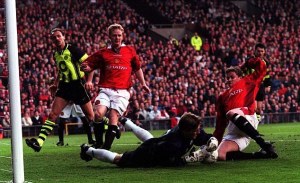
Manchester United lose to Dortmund in 1997, when only 5 English clubs occupied the top 50 spaces in Europe.
The Premier League often markets itself as the world’s strongest league, and certainly the Champions League performance of its elite teams between 2005 and 2012 testifies to that.
The fantastic Club Elo website keeps a historical rating of European clubs, dating back to the 1960s. Using this database, I was interested to see how the current level of English clubs relates to how the nation’s teams have performed historically.
What the Premier League looks like
The Premier League’s final standings for the 2012-13 season is notable for the division between the top seven and the rest. West Bromwich Albion finished 13 points above relegated Wigan in 18th, ten places below them, but 12 points off Liverpool in 7th.
Thirteen teams conceded more goals than they scored; this hasn’t happened since 2001-02. James Grayson noted that this split didn’t just exist on a results level, but at a performance level too.
Extra Time and the Away Goals Rule

Diego Forlan scores an extra time away goal at Anfield
I recently questioned the relevance of the away goals rule in normal time, and received a few responses that suggested the rule was particularly unfair in extra time as it gave the visiting team an extra half hour to find an away goal.
There’s a counterargument to this; that the rule balances out home advantage. This second leg home advantage is also often arbitrarily assigned in the later rounds of European competition.
Since the away goals rule was introduced to European football in the 1960s, the European Cup and UEFA Cup (and their more recent versions) have had 198 games enter extra time in two-legged, non-qualifying rounds. This sample excludes matches under the golden or silver goals rules.
Not just a tiebreaker: what goal difference tells us

Newcastle’s goal difference of +5 with 65 points suggests they overachieved by about 10 points in 2011/12
It’s the second-to-last column on every league table, but goal difference is a statistic rarely discussed in football. In the short term it can be a vital tiebreaker, but in the long term it is one of the most accessible indicators of the long term sustainability of a team’s results.
The relationship between goal difference and points is transparent and intuitive – better teams win more points, score more goals and concede fewer. The chart below shows most teams are closely scattered around the best fit line, which tells us how many points we’d expect from a team given their goal difference.

Landon Donovan twice proved to be a successful loan signing for Everton (image: Flickr/Ryan Healy)
This post is by Blake Wooster, Business Development Director at Prozone Sports, with support from Prozone Sports’ and 5 Added Minutes’ Omar Chaudhuri. Blake is one of football’s foremost experts in the area of performance analysis, talent identification, player development and recruitment. Since joining Prozone in 2004, Blake has achieved the highest industry accreditation in performance analysis and become a consultant and trusted advisor to a number of leading organisations worldwide, including Chelsea FC, UEFA, FIFA and the English Premier League. Follow him on Twitter @BlakeyGW, and Prozone Sports @ProzoneSports.
In Part I, I outlined some of the challenges inherent to recruiting players during the January window, and promised to offer some suggestions around how the application of data can enhance the task.
So here are a few ideas, and perhaps an insight into some of the work already being undertaken by the Technical Scouts. Of course, every transfer situation will be different and multi-faceted, but the underlying principles should be relevant if applied in the right context:
Read more…

Fernando Torres – a notable January transfer window purchase (image: Flickr/Ronnie Macdonald)
This post is by Blake Wooster, Business Development Director at Prozone Sports. Blake is one of football’s foremost experts in the area of performance analysis, talent identification, player development and recruitment. Since joining Prozone in 2004, Blake has achieved the highest industry accreditation in performance analysis and become a consultant and trusted advisor to a number of leading organisations worldwide, including Chelsea FC, UEFA, FIFA and the English Premier League. Follow him on Twitter @BlakeyGW, and Prozone Sports @ProzoneSports.
I haven’t read the morning papers, but I imagine the back pages are filled with speculation around Messrs Walcott, Villa, Lampard and Ronaldo and awash with clichés of ‘possible movers and shakers’ and clubs posed to ‘break open the war chest’ of funds.
Despite the media’s best efforts to whip up a transfer gossip frenzy, history tells us that the majority of deals don’t happen until the final day of the window (60% of the £225m spent in January 2011) and only 8% (21 of the 253 transfer predictions) of last year’s transfer gossip reported by the BBC actually materialised.
Hindsight bias in football

The 2012/13 Champions League second round draw pitted Manchester United against Real Madrid – a draw seen as inevitable by many
A Twitter search for ‘knew we’d get Madrid’ in the immediate wake of the Champions League second round draw revealed a small army of Manchester United supporters who claimed to have correctly predicted their opponents for the first knockout stage*.
Of course, a search of ‘think we’ll get Madrid’ revealed a much smaller sum of people. Prior to cup draws, most people acknowledge their random nature; that apart from a few pre-defined exceptions, your team has an equal chance of drawing any other team in the competition.
Yet after the result, people tend to see the outcome as being more predictable than it was before it took place. Psychologists call this hindsight bias, and cup draws are a very transparent example of this cognitive tendency.
Racism in English football – a fantasy league perspective

Can we gain insight into the level of racism in English football from the activity of fantasy managers?
In the last fifteen months, perhaps no topic has been as widely debated as racism in English football. Some observers have suggested that a number of high-profile incidents indicate that racism is on the rise, and more must be done to address the issue.
The scale of the discussion has been inflated by the media’s tendency to latch on to stories and turn them into a self-perpetuating narrative. This time last year, the BBC reported that compared to last season, “incidents of racist or indecent chanting rose 28% (for 31 to 43).” The headline statistic is hugely misleading – in absolute terms the rise in arrests was negligible, and as a proportion of all fans attending games it rose from 0.00024% to 0.00032%.
Examining momentum in 5-set tennis matches

Since 2001, no player has won more often from two sets down in Grand Slam matches than Roger Federer
For the first time, 5 Added Minutes takes on a non-football analysis.
The concept in question, however, is universal to sport: momentum. It’s a term often used by pundits to rationalise sequences of events – but to what extent does it actually exist?
Five-set tennis matches provide a test case to look at momentum. Often lasting longer than three and a half hours and with hundreds of individual points contested, there’s plenty of scope for the match to swing both ways.
BBC Price of Football survey: Analysis

The average price of the cheapest adult ticket has increased over 12 months, but what’s the premium on a Premier League ticket?
The BBC Price of Football survey has shed light on the phenomenal cost of following the modern game.
We know that the high demand for Premier League football means top-flight clubs can command a higher average ticket price than their counterparts in lower divisions, but I wanted to see exactly how much clubs charged their fans relative to what you might expect.
Understanding demand is often tricky – does demand drive prices or do prices drive demand? – but for the purposes of this exercise I’ve assumed clubs charge fans based on their willingness to attend games.

 5 Added Minutes